ADHD planning can feel like trying to organize your day while your brain opens 27 extra tabs. You sit down to make a plan, remember the laundry, go looking for a pen, notice a plant needs water, and somehow end up sorting a kitchen drawer.
The plan? Still waiting patiently.
If that sounds familiar, welcome. Let’s make room for a little humor—and a way to start that doesn’t require organizing your entire life before lunch.
ADHD Planning Starts With One Thing—Yes, Just One
A long to-do list can turn into a staring contest. You look at it. It looks at you. Nobody folds the towels.
For a gentler approach to ADHD planning, choose one thing you want to begin.
It might be paying a bill, answering an email, or making an appointment. Write it where you can see it and give yourself a clear starting point.
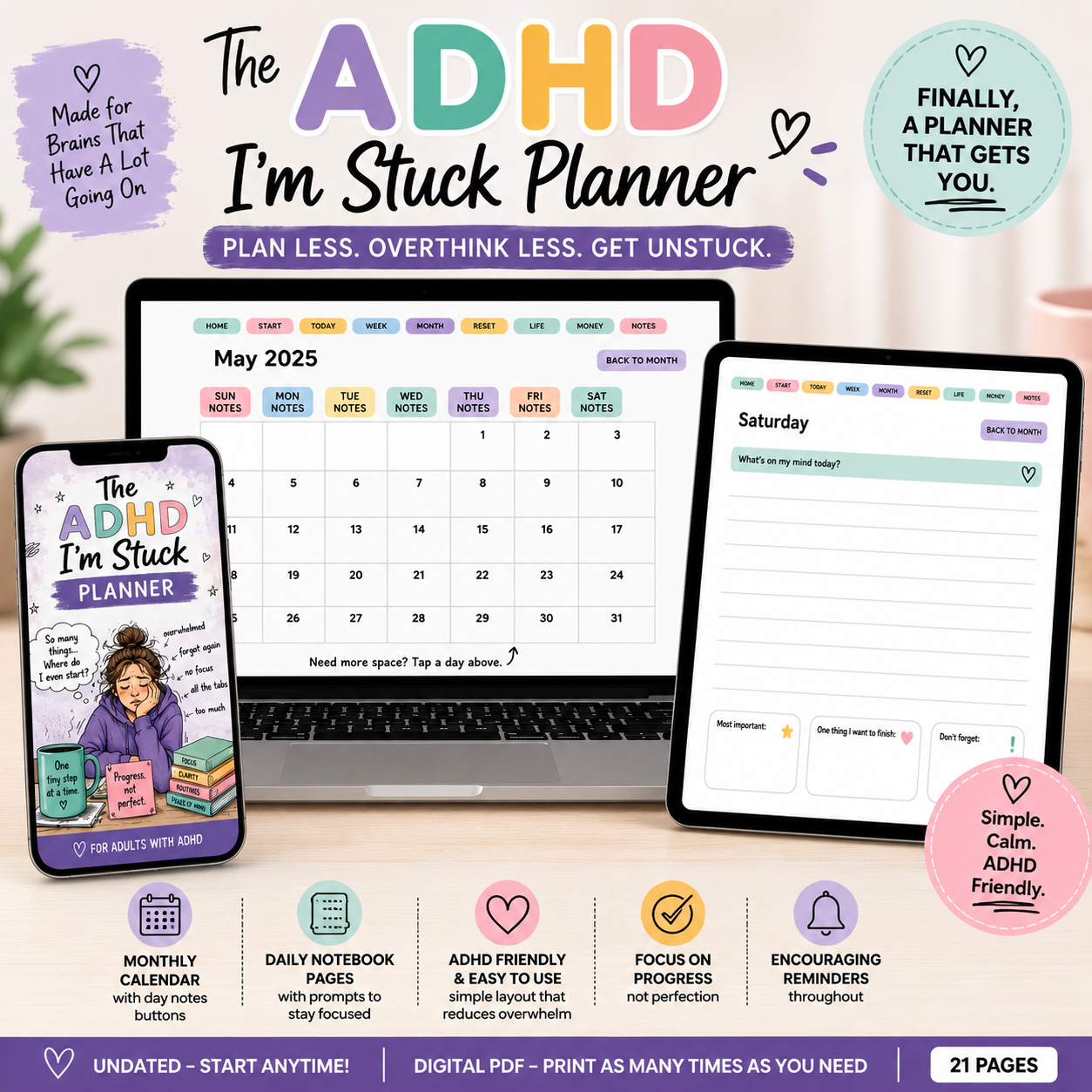
That’s actually why I created my ADHD I’m Stuck Planner. I wanted something simple that would help me focus on one step at a time instead of staring at a mile-long to-do list.
It’s an interactive digital planner with clickable calendars and fillable pages, designed to make planning feel a little less overwhelming.
Take a peek at my ADHD I’m Stuck Planner on Etsy — $14.99.
You can choose the next task later. It does not need to stand behind you tapping its foot.
Make the First Step Small Enough to Try
“Clean the kitchen” sounds like a whole afternoon.
“Put five dishes in the dishwasher” gives you somewhere to start.
Try turning a broad task into one specific action:
- Instead of “organize paperwork,” gather the papers into one pile.
- Instead of “work on my business,” open the draft you want to finish.
- Instead of “sort out appointments,” find the phone number for one office.
If you keep putting off a task, ask yourself: “What is the first action I could take?”
Make that your plan for now.
Give Wandering Thoughts a Parking Place
Sometimes you remember something unrelated right in the middle of a task.
You are answering an email when your brain announces, “We need batteries!”
Useful information. Interesting timing.
Keep a piece of paper or a notes app nearby. Jot down the thought so you can return to it later, then come back to what you were doing.
Your reminder has a parking space. It does not need to drive the whole day.
Plan Around the Day You Actually Have
A calendar can look wonderfully spacious until you add meals, errands, caregiving, appointments, and the time it takes to find your shoes.
Before adding tasks, write down the commitments already on your calendar. Then choose what reasonably fits around them.
Leave a little breathing room. Some tasks take longer than expected, and interruptions do not usually make reservations.
On a busy day, one useful task may be enough. Your plan can reflect your life as it is today.
Keep Your ADHD Planning Routine Simple
You do not have to build an elaborate system to begin.
Try keeping appointments and plans in one main place. Choose a regular moment to look at them—perhaps after breakfast or before you settle down for the evening.
Ask yourself:
- Is there an appointment or deadline I need to remember?
- What matters most today?
- What is one small step I can take next?
Use colors or reminders if you enjoy them. If decorating your planner becomes its own three-hour project, you are allowed to put down the stickers and write the appointment.
The planner can wear its fancy outfit another day.
Missed a Day? Come Back Today
An unused planner page is not a report card.
You do not have to fill in every missed day before using your planner again. Open it to where you are now and write down what you need next.
Plans change. Routines get interrupted. You can adjust without declaring the entire system a disaster.
A helpful question is: “What would make today a little easier?”
Start there.
A Simple Place to Begin
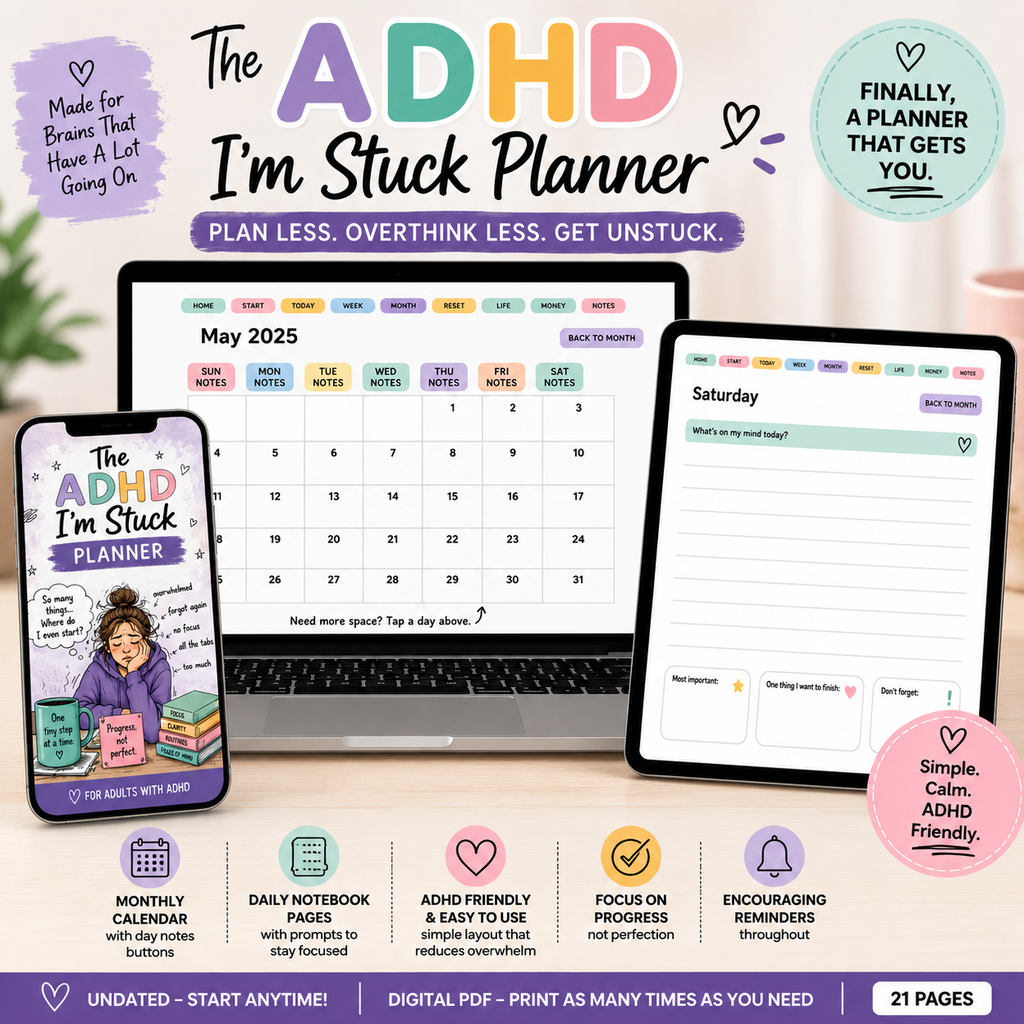
If you would like a place to keep your plans together, take a look at my ADHD One-Step Planner. Its interactive monthly calendar gives you a place to record appointments and plans, then return to them as your month unfolds.
You can also find my ADHD I’m Stuck Planner in my Etsy shop.
It is an organizational tool, and you can decide whether its layout suits the way you like to plan.
Whether you use a planner, a notebook, or a piece of paper, try beginning with one clear step.
Your brain may still have 27 tabs open. For now, you only need to choose the one you want to work on.